| Előző téma megtekintése :: Következő téma megtekintése |
| Szerző |
Üzenet |
caspert79 


Csatlakozott: 2010.10.31. Vasárnap 17:18
Hozzászólások: 3912
Tartózkodási hely: The Netherlands
|
 Elküldve: Pént. Jún. 07, 2024 5:06 pm Hozzászólás témája: e-front shutter curtain |
|
Elküldve: Pént. Jún. 07, 2024 5:06 pm Hozzászólás témája: e-front shutter curtain |
|
|
caspert79 wrote:
Just received a Manfrotto Element MII monopod, which is quite nice, being very lightweight, compact and affordable. Played a bit with it, and just found out how much the camera shutter (Sony A7RII in my case) actually can screw up critical sharpness. Playing around with longer shutter times really made that clear.
Had the e-front shutter curtain function turned OFF for a while now, because it can cause artifacts at very fast shutter speeds. But at medium and slower shutter speeds I can wholeheartedly recommend the e-front shutter curtain, because its effect is wat bigger than I ever realized. I will post some samples, once I find the time. |
|
| Vissza az elejére |
|
 |
kiddo

Csatlakozott: 2018.06.29. Péntek 22:38
Hozzászólások: 1630
|
Elküldve: Szomb. Jún. 08, 2024 5:43 am Hozzászólás témája: |
|
Elküldve: Szomb. Jún. 08, 2024 5:43 am Hozzászólás témája: |
|
|
kiddo wrote:
I'm curious about your results, ooh I assume for the A7II model doesn't work this option, right? |
|
| Vissza az elejére |
|
|
caspert79
Csatlakozott: 2010.10.31. Vasárnap 17:18
Hozzászólások: 3912
Tartózkodási hely: The Netherlands
|
Elküldve: Szomb. Jún. 08, 2024 6:56 am Hozzászólás témája: |
|
Elküldve: Szomb. Jún. 08, 2024 6:56 am Hozzászólás témája: |
|
|
caspert79 wrote:
Impact of applying e-front curtain on critical sharpness of image. The camera was used in combination with the Nikkor ai 135/3.5 and a monopod. With the e-front shutter function turned off, it's not possible to reach critical sharpness because of the shock created by the shutter action while the picture is being made. Conclusion: applying e-front curtain function is recommended when using slower / medium shutter speeds.
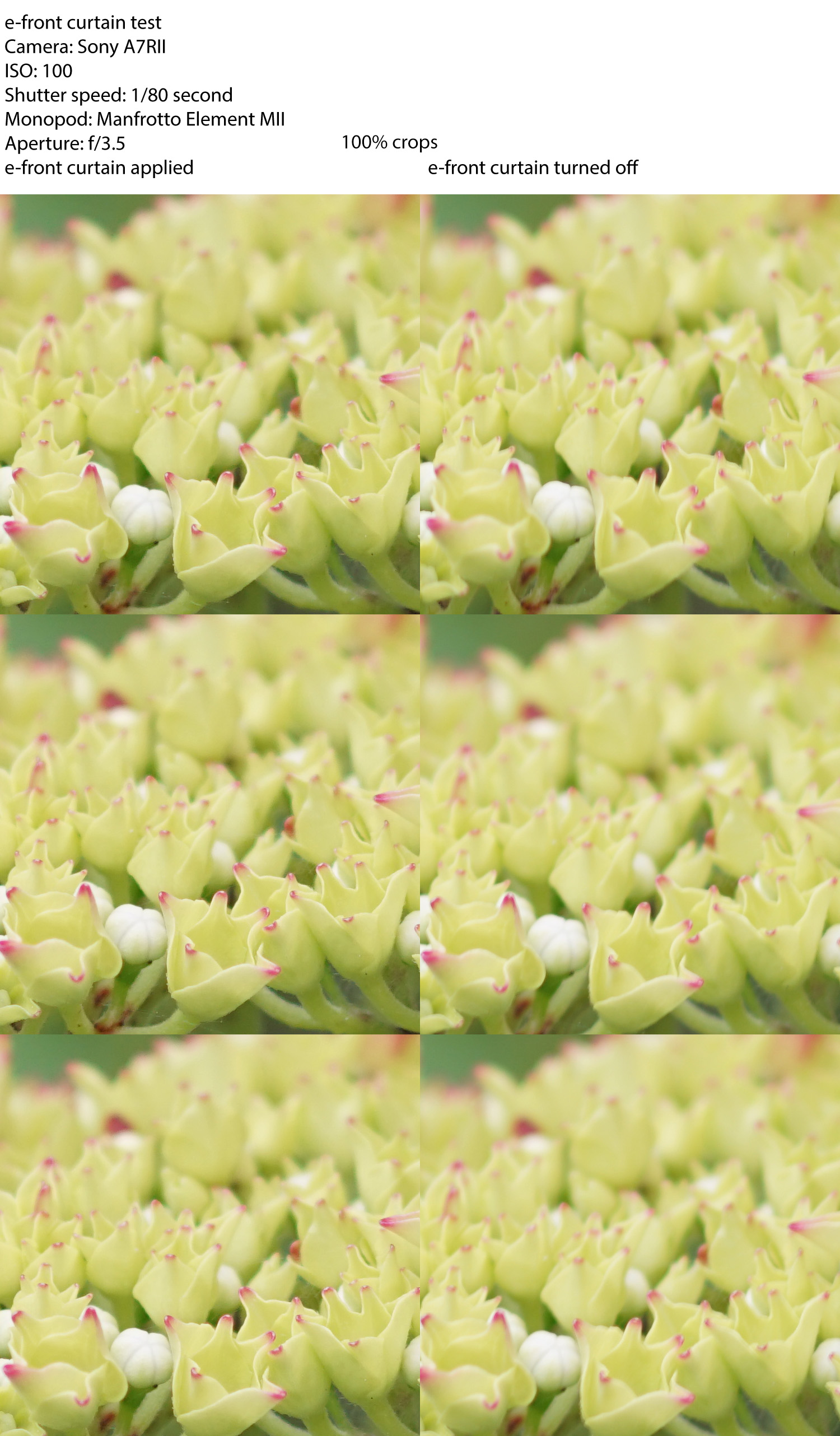 comparisonISO10035 by devoscasper, on Flickr
@Kiddo: my guess is, this also applies to the regular A7II. In my camera: MENU --> TAB2 --> page 5 |
|
| Vissza az elejére |
|
|
kiddo
Csatlakozott: 2018.06.29. Péntek 22:38
Hozzászólások: 1630
|
Elküldve: Szomb. Jún. 08, 2024 7:49 am Hozzászólás témája: |
|
Elküldve: Szomb. Jún. 08, 2024 7:49 am Hozzászólás témája: |
|
|
kiddo wrote:
Wow that's a huge difference , did you do enough tests to make sure what speed would be ok to use it or not with eshutter on/off?
What kind of artifacts would you get on high speeds ? |
|
| Vissza az elejére |
|
|
RokkorDoctor

Csatlakozott: 2021.11.27. Szombat 15:19
Hozzászólások: 1562
Tartózkodási hely: Kent, UK
Expire: 2025-05-01
|
Elküldve: Szomb. Jún. 08, 2024 8:01 am Hozzászólás témája: Re: e-front shutter curtain |
|
Elküldve: Szomb. Jún. 08, 2024 8:01 am Hozzászólás témája: Re: e-front shutter curtain |
|
|
RokkorDoctor wrote:
| caspert79 írta: |
Just received a Manfrotto Element MII monopod, which is quite nice, being very lightweight, compact and affordable. Played a bit with it, and just found out how much the camera shutter (Sony A7RII in my case) actually can screw up critical sharpness. Playing around with longer shutter times really made that clear.
Had the e-front shutter curtain function turned OFF for a while now, because it can cause artifacts at very fast shutter speeds. But at medium and slower shutter speeds I can wholeheartedly recommend the e-front shutter curtain, because its effect is wat bigger than I ever realized. I will post some samples, once I find the time. |
I think it is a combination of SONY's IBIS mechanical design + shutter vibration.
The idea with the A7xxx series models with IBIS is that you use IBIS when doing hand-held shooting, and turn IBIS off when the camera is mounted on a stable platform such as a tripod. I assume the theory is that with the camera mounted in a stable manner, noise and drift in the IBIS actuators will actually deteriorate image quality and therefore switching it off would help create sharper images, especially with longer exposure times mounted on a tripod.
However, IMO, SONY's big IBIS design flaw is that with IBIS switched off, the sensor is not mechanically locked in place. It is instead free to wobble on its ball bearings, and shutter vibration will then negatively affect the image.
It is one of the reasons I still like to use my A7S (which doesn't have IBIS). For tripod & studio macro work there are times when you really want the sensor to be solidly, rigidly mounted inside the camera body, and not floating on ball bearings.
It is not a new problem; in the film days each tripod also had its own resonance frequencies and there were certain shutter speeds best avoided during tripod use, especially if the camera did't have mirror lock-up.
EDIT: SONY could avoid this problem by modifying how IBIS off works: the sensor should be "parked" against two perpendicular reference surfaces or against three round reference stops.
_________________
Mark
SONY A7S, A7RII + dust-sealed modded Novoflex/Fotodiox/Rayqual MD-NEX adapters
Minolta SR-1, SRT-101/303, XD7/XD11, XGM, X700
Bronica SQAi
Ricoh GX100
Minolta majority of all Rokkor SR/AR/MC/MD models made
Sigma 14mm/3.5 for SR mount
Tamron SP 60B 300mm/2.8 (Adaptall)
Samyang T-S 24mm/3.5 (Nikon mount, DIY converted to SR mount)
Schneider-Kreuznach PC-Super-Angulon 28mm/2.8 (SR mount)
Bronica PS 35/40/50/65/80/110/135/150/180/200/250mm
A hozzászólás legutóbb RokkorDoctor által Szomb. Jún. 08, 2024 8:12 am-kor lett szerkesztve, összesen 1 alkalommal. |
|
| Vissza az elejére |
|
|
caspert79
Csatlakozott: 2010.10.31. Vasárnap 17:18
Hozzászólások: 3912
Tartózkodási hely: The Netherlands
|
Elküldve: Szomb. Jún. 08, 2024 8:08 am Hozzászólás témája: |
|
Elküldve: Szomb. Jún. 08, 2024 8:08 am Hozzászólás témája: |
|
|
caspert79 wrote:
Interesting point, i will probably do a second test with IBIS turned off. |
|
| Vissza az elejére |
|
|
caspert79
Csatlakozott: 2010.10.31. Vasárnap 17:18
Hozzászólások: 3912
Tartózkodási hely: The Netherlands
|
Elküldve: Szomb. Jún. 08, 2024 8:14 am Hozzászólás témája: |
|
Elküldve: Szomb. Jún. 08, 2024 8:14 am Hozzászólás témája: |
|
|
caspert79 wrote:
| kiddo írta: |
Wow that's a huge difference , did you do enough tests to make sure what speed would be ok to use it or not with eshutter on/off?
What kind of artifacts would you get on high speeds ? |
No didn’t test that yet.
I remember certain fast lenses (and thus high shutter speeds) that performed less good (i believe in periphery and bokeh) when using the eshutter. E shutters can also give issues with moving subjects. |
|
| Vissza az elejére |
|
|
blotafton

Csatlakozott: 2013.08.08. Csütörtök 18:56
Hozzászólások: 1794
Tartózkodási hely: Sweden
|
Elküldve: Szomb. Jún. 08, 2024 11:17 am Hozzászólás témája: |
|
Elküldve: Szomb. Jún. 08, 2024 11:17 am Hozzászólás témája: |
|
|
blotafton wrote:
Interesting results.
I have the regular Sony a7 and have not seen this. I can keep it in the mechanical shutter mode with good sharpness. But it's only 24mp.
It doesn't have IBIS so that is a good thing to test. |
|
| Vissza az elejére |
|
|
visualopsins

Csatlakozott: 2009.03.05. Csütörtök 19:40
Hozzászólások: 11699
Tartózkodási hely: California
Expire: 2027-07-11
|
Elküldve: Szomb. Jún. 08, 2024 12:31 pm Hozzászólás témája: |
|
Elküldve: Szomb. Jún. 08, 2024 12:31 pm Hozzászólás témája: |
|
|
visualopsins wrote:
Monopod? Solid non-movable tripod mount seems easier to get the most similar test conditions where the only difference is the e-curtain (and IBIS) setting, without introducing monopod positioning errors.
 very much for tests!
_________________
☮☮☮☮☮☮☮☮☮☮☮☮☮☮☮☮☮☮☮☮☮☮☮☮☮☮☮☮☮☮☮☮ like attracts like! ☮☮☮☮☮☮☮☮☮☮☮☮☮☮☮☮☮☮☮☮☮☮☮☮☮☮☮☮☮☮☮☮
Cameras: Sony ILCE-7RM2, Spotmatics II, F, and ESII, Nikon P4
Lenses:
M42 Asahi Optical Co., Takumar 1:4 f=35mm, 1:2 f=58mm (Sonnar), 1:2.4 f=58mm (Heliar), 1:2.2 f=55mm (Gaussian), 1:2.8 f=105mm (Model I), 1:2.8/105 (Model II), 1:5.6/200, Tele-Takumar 1:5.6/200, 1:6.3/300, Macro-Takumar 1:4/50, Auto-Takumar 1:2.3 f=35, 1:1.8 f=55mm, 1:2.2 f=55mm, Super-TAKUMAR 1:3.5/28 (fat), 1:2/35 (Fat), 1:1.4/50 (8-element), Super-Multi-Coated Fisheye-TAKUMAR 1:4/17, Super-Multi-Coated TAKUMAR 1:4.5/20, 1:3.5/24, 1:3.5/28, 1:2/35, 1:3.5/35, 1:1.8/85, 1:1.9/85 1:2.8/105, 1:3.5/135, 1:2.5/135 (II), 1:4/150, 1:4/200, 1:4/300, 1:4.5/500, Super-Multi-Coated Macro-TAKUMAR 1:4/50, 1:4/100, Super-Multi-Coated Bellows-TAKUMAR 1:4/100, SMC TAKUMAR 1:1.4/50, 1:1.8/55
M42 Carl Zeiss Jena Flektogon 2.4/35
Contax Carl Zeiss Vario-Sonnar T* 28-70mm F3.5-4.5
Pentax K-mount SMC PENTAX-A ZOOM 1:3.5 35~105mm, SMC PENTAX ZOOM 1:4 45~125mm
Nikon Micro-NIKKOR-P-C Auto 1:3.5 f=55mm, NIKKOR-P Auto 105mm f/2.5 Pre-AI (Sonnar), Micro-NIKKOR 105mm 1:4 AI, NIKKOR AI-S 35-135mm f/3,5-4,5
Solinon 1:5.6/18 ASPH.
Tamron SP 17mm f/3.5 (51B), Tamron SP 17mm f/3.5 (151B), SP 500mm f/8 (55BB), SP 70-210mm f/3.5 (19AH)
Vivitar 100mm 1:2.8 MC 1:1 Macro Telephoto (Kiron)
|
|
| Vissza az elejére |
|
|
alex_d
Csatlakozott: 2019.01.19. Szombat 9:00
Hozzászólások: 553
|
Elküldve: Szomb. Jún. 08, 2024 1:12 pm Hozzászólás témája: |
|
Elküldve: Szomb. Jún. 08, 2024 1:12 pm Hozzászólás témája: |
|
|
alex_d wrote:
its a perfect upgrade to non-ibis bodies, and cheapest replacement (aka work-around) for an ibis,
i went from slowest 1/30 for street to 1/15 .. 1/8 evening/night shots,
the monopod is a vintage alu one, smallest and lightest of any i have ever had or seen.
I do keep 'a sturdy' one for in the wilds.
Or riots 
_________________
**
// See my selling items in the Market place
now with pics
** |
|
| Vissza az elejére |
|
|
caspert79
Csatlakozott: 2010.10.31. Vasárnap 17:18
Hozzászólások: 3912
Tartózkodási hely: The Netherlands
|
Elküldve: Szomb. Jún. 08, 2024 5:48 pm Hozzászólás témája: |
|
Elküldve: Szomb. Jún. 08, 2024 5:48 pm Hozzászólás témája: |
|
|
caspert79 wrote:
Here a similar test, but with IBIS turned off:
 comparisonISO25035 by devoscasper, on Flickr
Had to increase ISO to 250 to maintain same shutter speed as in the first test, I don't see a significant difference between e-curtain ON or OFF when IBIS is turned OFF.
It seems that the combination IBIS ON + e-curtain turned ON leads to the best results (at least when used on a monopod). |
|
| Vissza az elejére |
|
|
caspert79
Csatlakozott: 2010.10.31. Vasárnap 17:18
Hozzászólások: 3912
Tartózkodási hely: The Netherlands
|
Elküldve: Szomb. Jún. 08, 2024 6:16 pm Hozzászólás témája: |
|
Elküldve: Szomb. Jún. 08, 2024 6:16 pm Hozzászólás témája: |
|
|
caspert79 wrote:
| visualopsins írta: |
Monopod? Solid non-movable tripod mount seems easier to get the most similar test conditions where the only difference is the e-curtain (and IBIS) setting, without introducing monopod positioning errors.
very much for tests! |
I’m currently interested in getting the maximum benefits when using a monopod. I always seem to get great results with a tripod, also with IBIS turned on and e-curtain turned off. |
|
| Vissza az elejére |
|
|
visualopsins
Csatlakozott: 2009.03.05. Csütörtök 19:40
Hozzászólások: 11699
Tartózkodási hely: California
Expire: 2027-07-11
|
Elküldve: Szomb. Jún. 08, 2024 6:24 pm Hozzászólás témája: |
|
Elküldve: Szomb. Jún. 08, 2024 6:24 pm Hozzászólás témája: |
|
|
visualopsins wrote:
| caspert79 írta: |
| visualopsins írta: |
Monopod? Solid non-movable tripod mount seems easier to get the most similar test conditions where the only difference is the e-curtain (and IBIS) setting, without introducing monopod positioning errors.
very much for tests! |
I’m currently interested in getting the maximum benefits when using a monopod. I always seem to get great results with a tripod, also with IBIS turned on and e-curtain turned off. |
Unconscious personal bias could be skewing results? Monopod position changes between settings. How are you refocusing?
Actually, with your experience and skill I think your results are likely valid, but the testing method isn't repeatable.
_________________
☮☮☮☮☮☮☮☮☮☮☮☮☮☮☮☮☮☮☮☮☮☮☮☮☮☮☮☮☮☮☮☮ like attracts like! ☮☮☮☮☮☮☮☮☮☮☮☮☮☮☮☮☮☮☮☮☮☮☮☮☮☮☮☮☮☮☮☮
Cameras: Sony ILCE-7RM2, Spotmatics II, F, and ESII, Nikon P4
Lenses:
M42 Asahi Optical Co., Takumar 1:4 f=35mm, 1:2 f=58mm (Sonnar), 1:2.4 f=58mm (Heliar), 1:2.2 f=55mm (Gaussian), 1:2.8 f=105mm (Model I), 1:2.8/105 (Model II), 1:5.6/200, Tele-Takumar 1:5.6/200, 1:6.3/300, Macro-Takumar 1:4/50, Auto-Takumar 1:2.3 f=35, 1:1.8 f=55mm, 1:2.2 f=55mm, Super-TAKUMAR 1:3.5/28 (fat), 1:2/35 (Fat), 1:1.4/50 (8-element), Super-Multi-Coated Fisheye-TAKUMAR 1:4/17, Super-Multi-Coated TAKUMAR 1:4.5/20, 1:3.5/24, 1:3.5/28, 1:2/35, 1:3.5/35, 1:1.8/85, 1:1.9/85 1:2.8/105, 1:3.5/135, 1:2.5/135 (II), 1:4/150, 1:4/200, 1:4/300, 1:4.5/500, Super-Multi-Coated Macro-TAKUMAR 1:4/50, 1:4/100, Super-Multi-Coated Bellows-TAKUMAR 1:4/100, SMC TAKUMAR 1:1.4/50, 1:1.8/55
M42 Carl Zeiss Jena Flektogon 2.4/35
Contax Carl Zeiss Vario-Sonnar T* 28-70mm F3.5-4.5
Pentax K-mount SMC PENTAX-A ZOOM 1:3.5 35~105mm, SMC PENTAX ZOOM 1:4 45~125mm
Nikon Micro-NIKKOR-P-C Auto 1:3.5 f=55mm, NIKKOR-P Auto 105mm f/2.5 Pre-AI (Sonnar), Micro-NIKKOR 105mm 1:4 AI, NIKKOR AI-S 35-135mm f/3,5-4,5
Solinon 1:5.6/18 ASPH.
Tamron SP 17mm f/3.5 (51B), Tamron SP 17mm f/3.5 (151B), SP 500mm f/8 (55BB), SP 70-210mm f/3.5 (19AH)
Vivitar 100mm 1:2.8 MC 1:1 Macro Telephoto (Kiron)
|
|
| Vissza az elejére |
|
|
caspert79
Csatlakozott: 2010.10.31. Vasárnap 17:18
Hozzászólások: 3912
Tartózkodási hely: The Netherlands
|
Elküldve: Szomb. Jún. 08, 2024 6:33 pm Hozzászólás témája: |
|
Elküldve: Szomb. Jún. 08, 2024 6:33 pm Hozzászólás témája: |
|
|
caspert79 wrote:
| visualopsins írta: |
| caspert79 írta: |
| visualopsins írta: |
Monopod? Solid non-movable tripod mount seems easier to get the most similar test conditions where the only difference is the e-curtain (and IBIS) setting, without introducing monopod positioning errors.
very much for tests! |
I’m currently interested in getting the maximum benefits when using a monopod. I always seem to get great results with a tripod, also with IBIS turned on and e-curtain turned off. |
Unconscious personal bias could be skewing results? Monopod position changes between settings. How are you refocusing?
Actually, with your experience and skill I think your results are likely valid, but the testing method isn't repeatable. |
It’s not an absolutely reliable method, but if it was a focusing issue, there should be sharpness somewhere in the frame. But this is not the case: it seems to be unsharpness because of movement. I did three shots to see if the findings are consistent. Of course 10x would be even better. |
|
| Vissza az elejére |
|
|
visualopsins
Csatlakozott: 2009.03.05. Csütörtök 19:40
Hozzászólások: 11699
Tartózkodási hely: California
Expire: 2027-07-11
|
Elküldve: Szomb. Jún. 08, 2024 8:03 pm Hozzászólás témája: |
|
Elküldve: Szomb. Jún. 08, 2024 8:03 pm Hozzászólás témája: |
|
|
visualopsins wrote:
| caspert79 írta: |
| visualopsins írta: |
| caspert79 írta: |
| visualopsins írta: |
Monopod? Solid non-movable tripod mount seems easier to get the most similar test conditions where the only difference is the e-curtain (and IBIS) setting, without introducing monopod positioning errors.
very much for tests! |
I’m currently interested in getting the maximum benefits when using a monopod. I always seem to get great results with a tripod, also with IBIS turned on and e-curtain turned off. |
Unconscious personal bias could be skewing results? Monopod position changes between settings. How are you refocusing?
Actually, with your experience and skill I think your results are likely valid, but the testing method isn't repeatable. |
It’s not an absolutely reliable method, but if it was a focusing issue, there should be sharpness somewhere in the frame. But this is not the case: it seems to be unsharpness because of movement. I did three shots to see if the findings are consistent. Of course 10x would be even better. |
Yes, but no sharpness somewhere in frame could also be (identical) missed focus causing the unsharpness. Logical but I don't think it's missed focus...
Thanks again for the tests!!! Looking at your results:
Test 1 with steadyshot on I think e-shutter on gives best results.
Test 2 with steadyshot off I think e-shutter off gives best results.
Conclusions:
Comparing Test 1 and Test 2, having both features on gives best results.
When using either steadyshot or e-shutter feature, both features should be on.
The results support what RokkorDoctor says, the steadyshot off loose sensor is being vibrated by shutter(s).
Tests with a solid tripod mount would probably also show steadyshot on and e-shutter on is best, which goes against traditional recommendations, at or near system resonance from shutter vibration, but away from resonance, steadyshot drift will have more effect, so steadyshot off would give best results...
_________________
☮☮☮☮☮☮☮☮☮☮☮☮☮☮☮☮☮☮☮☮☮☮☮☮☮☮☮☮☮☮☮☮ like attracts like! ☮☮☮☮☮☮☮☮☮☮☮☮☮☮☮☮☮☮☮☮☮☮☮☮☮☮☮☮☮☮☮☮
Cameras: Sony ILCE-7RM2, Spotmatics II, F, and ESII, Nikon P4
Lenses:
M42 Asahi Optical Co., Takumar 1:4 f=35mm, 1:2 f=58mm (Sonnar), 1:2.4 f=58mm (Heliar), 1:2.2 f=55mm (Gaussian), 1:2.8 f=105mm (Model I), 1:2.8/105 (Model II), 1:5.6/200, Tele-Takumar 1:5.6/200, 1:6.3/300, Macro-Takumar 1:4/50, Auto-Takumar 1:2.3 f=35, 1:1.8 f=55mm, 1:2.2 f=55mm, Super-TAKUMAR 1:3.5/28 (fat), 1:2/35 (Fat), 1:1.4/50 (8-element), Super-Multi-Coated Fisheye-TAKUMAR 1:4/17, Super-Multi-Coated TAKUMAR 1:4.5/20, 1:3.5/24, 1:3.5/28, 1:2/35, 1:3.5/35, 1:1.8/85, 1:1.9/85 1:2.8/105, 1:3.5/135, 1:2.5/135 (II), 1:4/150, 1:4/200, 1:4/300, 1:4.5/500, Super-Multi-Coated Macro-TAKUMAR 1:4/50, 1:4/100, Super-Multi-Coated Bellows-TAKUMAR 1:4/100, SMC TAKUMAR 1:1.4/50, 1:1.8/55
M42 Carl Zeiss Jena Flektogon 2.4/35
Contax Carl Zeiss Vario-Sonnar T* 28-70mm F3.5-4.5
Pentax K-mount SMC PENTAX-A ZOOM 1:3.5 35~105mm, SMC PENTAX ZOOM 1:4 45~125mm
Nikon Micro-NIKKOR-P-C Auto 1:3.5 f=55mm, NIKKOR-P Auto 105mm f/2.5 Pre-AI (Sonnar), Micro-NIKKOR 105mm 1:4 AI, NIKKOR AI-S 35-135mm f/3,5-4,5
Solinon 1:5.6/18 ASPH.
Tamron SP 17mm f/3.5 (51B), Tamron SP 17mm f/3.5 (151B), SP 500mm f/8 (55BB), SP 70-210mm f/3.5 (19AH)
Vivitar 100mm 1:2.8 MC 1:1 Macro Telephoto (Kiron)
|
|
| Vissza az elejére |
|
|
caspert79
Csatlakozott: 2010.10.31. Vasárnap 17:18
Hozzászólások: 3912
Tartózkodási hely: The Netherlands
|
Elküldve: Vas. Jún. 09, 2024 7:02 am Hozzászólás témája: |
|
Elküldve: Vas. Jún. 09, 2024 7:02 am Hozzászólás témája: |
|
|
caspert79 wrote:
| visualopsins írta: |
Thanks again for the tests!!! Looking at your results:
Test 1 with steadyshot on I think e-shutter on gives best results.
Test 2 with steadyshot off I think e-shutter off gives best results.
|
I agree with your first observation. And in general, I seem to get best results with IBIS and e-curtain turned on. The results of test 2 are still somewhat unclear to me. I'll try to do a second test to see if the results are reproducable. |
|
| Vissza az elejére |
|
|
caspert79
Csatlakozott: 2010.10.31. Vasárnap 17:18
Hozzászólások: 3912
Tartózkodási hely: The Netherlands
|
Elküldve: Vas. Jún. 09, 2024 8:02 am Hozzászólás témája: |
|
Elküldve: Vas. Jún. 09, 2024 8:02 am Hozzászólás témája: |
|
|
caspert79 wrote:
OK, I tried to improve my test a bit by changing the following conditions:
- Using a 50mm lens, instead of 135mm, so increasing the DOF and decreasing the chance of misfocusing
- Use a smaller aperture, to further increase DOF
- Slower shutter speed by rato of focal length, from 1/80 sec (135mm lens) to 1/30 sec (50mm lens)
- Increase the amount of pictures per condition to 5
- Using a more static subject (i cut off the flower, put it on a hard surface and stabilized it) so wind can play no role.
First, with IBIS turned on:
 comparison IBIS on by devoscasper, on Flickr
Then, with IBIS turned off:
 comparison IBIS off by devoscasper, on Flickr
With image stabilization turned ON, e-front curtain ON is beneficial to sharpness. It seems IBIS can cope pretty well with hand-created movements, but not with shutter shock.
With image stabilization turned OFF, it's hard to consistently get sharp results, no matter if the e-front curtain is ON or OFF. The use of a monopod is not enough to assure sharp images at slow shutter speeds, and IBIS is useful in this case. |
|
| Vissza az elejére |
|
|
RokkorDoctor
Csatlakozott: 2021.11.27. Szombat 15:19
Hozzászólások: 1562
Tartózkodási hely: Kent, UK
Expire: 2025-05-01
|
Elküldve: Vas. Jún. 09, 2024 8:35 am Hozzászólás témája: |
|
Elküldve: Vas. Jún. 09, 2024 8:35 am Hozzászólás témája: |
|
|
RokkorDoctor wrote:
On a monopod I would definitely think use of IBIS is beneficial. Whilst a monopod helps steady a shot, it is far from a stable platform.
Full frame sensor IBIS only really works well for a relatively low band of frequencies (e.g. hand tremor and general unsteadiness of the body). It is not primarily designed to offset high frequency vibrations such as camera body and tripod resonance (this may well be different for GoPro type of action cameras with small lightweight sensors that are designed for different use cases; they can likely stabilise up to much higher frequencies)
Thus there are always going to be borderline situations where you have to experiment and see if IBIS is a hinder or a help given the chosen camera mounting and shutter speed.
I still think SONY made a mistake by not ensuring that IBIS OFF = fixed sensor. This was likely a cost issue; simply turning off the actuators is cheaper than engineering a mechanical parking reference stop for the sensor. IBIS cameras I think were primarily designed to be used with IBIS on, the IBIS off feature was probably a software-mod afterthought when they discovered IBIS permanently ON could occasionally cause problems.
For some photography (especially bench-mounted macro and micro photography) I would advise the use of a camera without IBIS that has a fixed sensor.
_________________
Mark
SONY A7S, A7RII + dust-sealed modded Novoflex/Fotodiox/Rayqual MD-NEX adapters
Minolta SR-1, SRT-101/303, XD7/XD11, XGM, X700
Bronica SQAi
Ricoh GX100
Minolta majority of all Rokkor SR/AR/MC/MD models made
Sigma 14mm/3.5 for SR mount
Tamron SP 60B 300mm/2.8 (Adaptall)
Samyang T-S 24mm/3.5 (Nikon mount, DIY converted to SR mount)
Schneider-Kreuznach PC-Super-Angulon 28mm/2.8 (SR mount)
Bronica PS 35/40/50/65/80/110/135/150/180/200/250mm |
|
| Vissza az elejére |
|
|
caspert79
Csatlakozott: 2010.10.31. Vasárnap 17:18
Hozzászólások: 3912
Tartózkodási hely: The Netherlands
|
Elküldve: Vas. Jún. 09, 2024 8:58 am Hozzászólás témája: |
|
Elküldve: Vas. Jún. 09, 2024 8:58 am Hozzászólás témája: |
|
|
caspert79 wrote:
| RokkorDoctor írta: |
On a monopod I would definitely think use of IBIS is beneficial. Whilst a monopod helps steady a shot, it is far from a stable platform.
Full frame sensor IBIS only really works well for a relatively low band of frequencies (e.g. hand tremor and general unsteadiness of the body). It is not primarily designed to offset high frequency vibrations such as camera body and tripod resonance (this may well be different for GoPro type of action cameras with small lightweight sensors that are designed for different use cases; they can likely stabilise up to much higher frequencies)
Thus there are always going to be borderline situations where you have to experiment and see if IBIS is a hinder or a help given the chosen camera mounting and shutter speed.
I still think SONY made a mistake by not ensuring that IBIS OFF = fixed sensor. This was likely a cost issue; simply turning off the actuators is cheaper than engineering a mechanical parking reference stop for the sensor. IBIS cameras I think were primarily designed to be used with IBIS on, the IBIS off feature was probably a software-mod afterthought when they discovered IBIS permanently ON could occasionally cause problems.
For some photography (especially bench-mounted macro and micro photography) I would advise the use of a camera without IBIS that has a fixed sensor. |
True, it doesn't sound like the best system in theory, although I never experienced any issues with it. And this included macro's / focus stacking. The weakest point of the Sony IMO is the ergonomics; it's not all that intuitive. |
|
| Vissza az elejére |
|
|
visualopsins
Csatlakozott: 2009.03.05. Csütörtök 19:40
Hozzászólások: 11699
Tartózkodási hely: California
Expire: 2027-07-11
|
Elküldve: Vas. Jún. 09, 2024 5:45 pm Hozzászólás témája: |
|
Elküldve: Vas. Jún. 09, 2024 5:45 pm Hozzászólás témája: |
|
|
visualopsins wrote:
 IBIS always on -- at some point electronics are "clean" enough making drift so low IBIS always on solves the parking design solution. There would be no need for IBIS off switch. Are we here?
_________________
☮☮☮☮☮☮☮☮☮☮☮☮☮☮☮☮☮☮☮☮☮☮☮☮☮☮☮☮☮☮☮☮ like attracts like! ☮☮☮☮☮☮☮☮☮☮☮☮☮☮☮☮☮☮☮☮☮☮☮☮☮☮☮☮☮☮☮☮
Cameras: Sony ILCE-7RM2, Spotmatics II, F, and ESII, Nikon P4
Lenses:
M42 Asahi Optical Co., Takumar 1:4 f=35mm, 1:2 f=58mm (Sonnar), 1:2.4 f=58mm (Heliar), 1:2.2 f=55mm (Gaussian), 1:2.8 f=105mm (Model I), 1:2.8/105 (Model II), 1:5.6/200, Tele-Takumar 1:5.6/200, 1:6.3/300, Macro-Takumar 1:4/50, Auto-Takumar 1:2.3 f=35, 1:1.8 f=55mm, 1:2.2 f=55mm, Super-TAKUMAR 1:3.5/28 (fat), 1:2/35 (Fat), 1:1.4/50 (8-element), Super-Multi-Coated Fisheye-TAKUMAR 1:4/17, Super-Multi-Coated TAKUMAR 1:4.5/20, 1:3.5/24, 1:3.5/28, 1:2/35, 1:3.5/35, 1:1.8/85, 1:1.9/85 1:2.8/105, 1:3.5/135, 1:2.5/135 (II), 1:4/150, 1:4/200, 1:4/300, 1:4.5/500, Super-Multi-Coated Macro-TAKUMAR 1:4/50, 1:4/100, Super-Multi-Coated Bellows-TAKUMAR 1:4/100, SMC TAKUMAR 1:1.4/50, 1:1.8/55
M42 Carl Zeiss Jena Flektogon 2.4/35
Contax Carl Zeiss Vario-Sonnar T* 28-70mm F3.5-4.5
Pentax K-mount SMC PENTAX-A ZOOM 1:3.5 35~105mm, SMC PENTAX ZOOM 1:4 45~125mm
Nikon Micro-NIKKOR-P-C Auto 1:3.5 f=55mm, NIKKOR-P Auto 105mm f/2.5 Pre-AI (Sonnar), Micro-NIKKOR 105mm 1:4 AI, NIKKOR AI-S 35-135mm f/3,5-4,5
Solinon 1:5.6/18 ASPH.
Tamron SP 17mm f/3.5 (51B), Tamron SP 17mm f/3.5 (151B), SP 500mm f/8 (55BB), SP 70-210mm f/3.5 (19AH)
Vivitar 100mm 1:2.8 MC 1:1 Macro Telephoto (Kiron)
|
|
| Vissza az elejére |
|
|
|
|
 Magyar
 Español
 中文
 Русский
 Deutsch
 日本語
 Français


